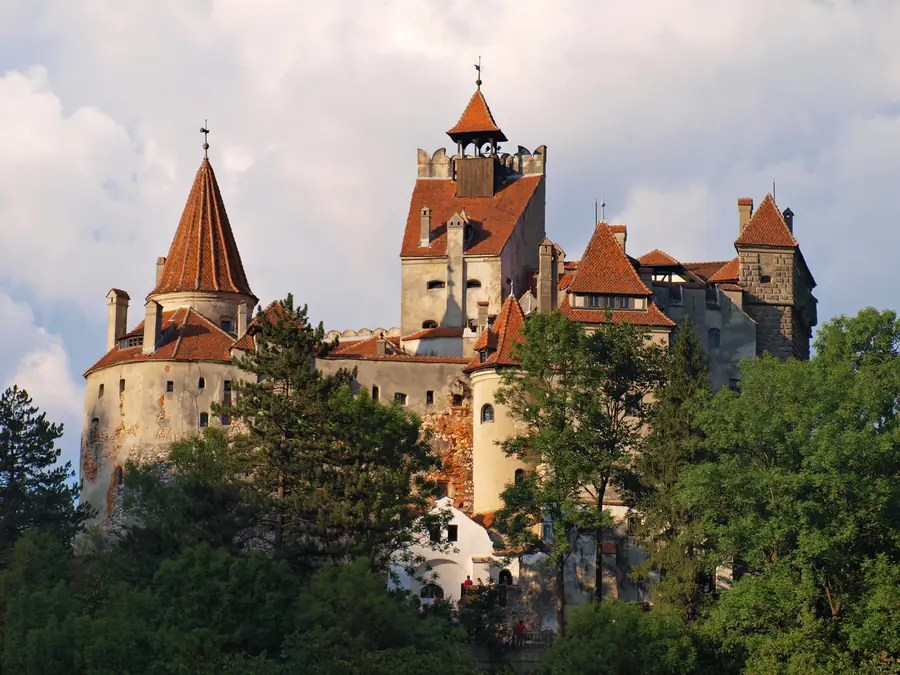
Transylvania is the region most visitors imagine when they think of Romania: castles on forested hills, walled towns, fortified churches and villages that seem unchanged for centuries. It is also easy to explore, with short distances between its main sights.
Brașov and Bran Brașov is a good base. Its Council Square is surrounded by pastel-coloured houses, and the Black Church is one of the largest Gothic churches in southeastern Europe. A cable car takes you up Tâmpa Mountain for a view over the old town. Nearby, Bran Castle, a medieval fortress overlooking a mountain pass, is often described as the most visited castle in Romania and is popularly linked with the Dracula legend. Rașnov Fortress, close by, is quieter and offers wide views.
Peleș Castle in Sinaia Peleș Castle, built between 1873 and 1914 as a summer residence for the Romanian royal family, is a Neo-Renaissance palace in a forest setting, with richly decorated rooms. Sinaia also has a monastery and is a gateway to the Bucegi Mountains.
Sibiu and Sighișoara Sibiu was a European Capital of Culture in 2007. Its Large Square, the Bridge of Lies and the roofs with small windows that seem to watch passers-by give the city a distinctive character. Sighișoara is one of the best-preserved inhabited medieval citadels in Europe and a UNESCO World Heritage Site. Climb the Clock Tower, walk the covered stairway to the church on the hill and try to imagine the town in the fifteenth century, when, according to tradition, Vlad the Impaler was born here.
Fortified churches and villages Saxon settlers built villages around churches that doubled as fortresses. Viscri, with its fortified church, is part of a UNESCO World Heritage listing of Transylvanian villages with fortified churches, together with Biertan and other sites. Visiting them gives a sense of how communities lived and defended themselves.
More to explore Alba Iulia has a large eighteenth-century star-shaped citadel. Hunedoara is home to Corvin Castle, a Gothic and Renaissance fortress. Cluj-Napoca is a lively university city with a good food and music scene.
When to go Spring and autumn are pleasant, with mild weather and fewer crowds. Summer is busy but ideal for the mountains. In December the Christmas markets of Sibiu and Brașov are among the most atmospheric in the country.
Food Try sarmale (stuffed cabbage rolls), polenta with cheese and sour cream, papanași (fried doughnuts with jam and cream) and, in Szekler areas, kürtőskalács, a sweet chimney cake baked over embers.
Transylvania rewards slow travel: stay in a guesthouse in a village, walk the old streets in the evening and let the stories find you.